
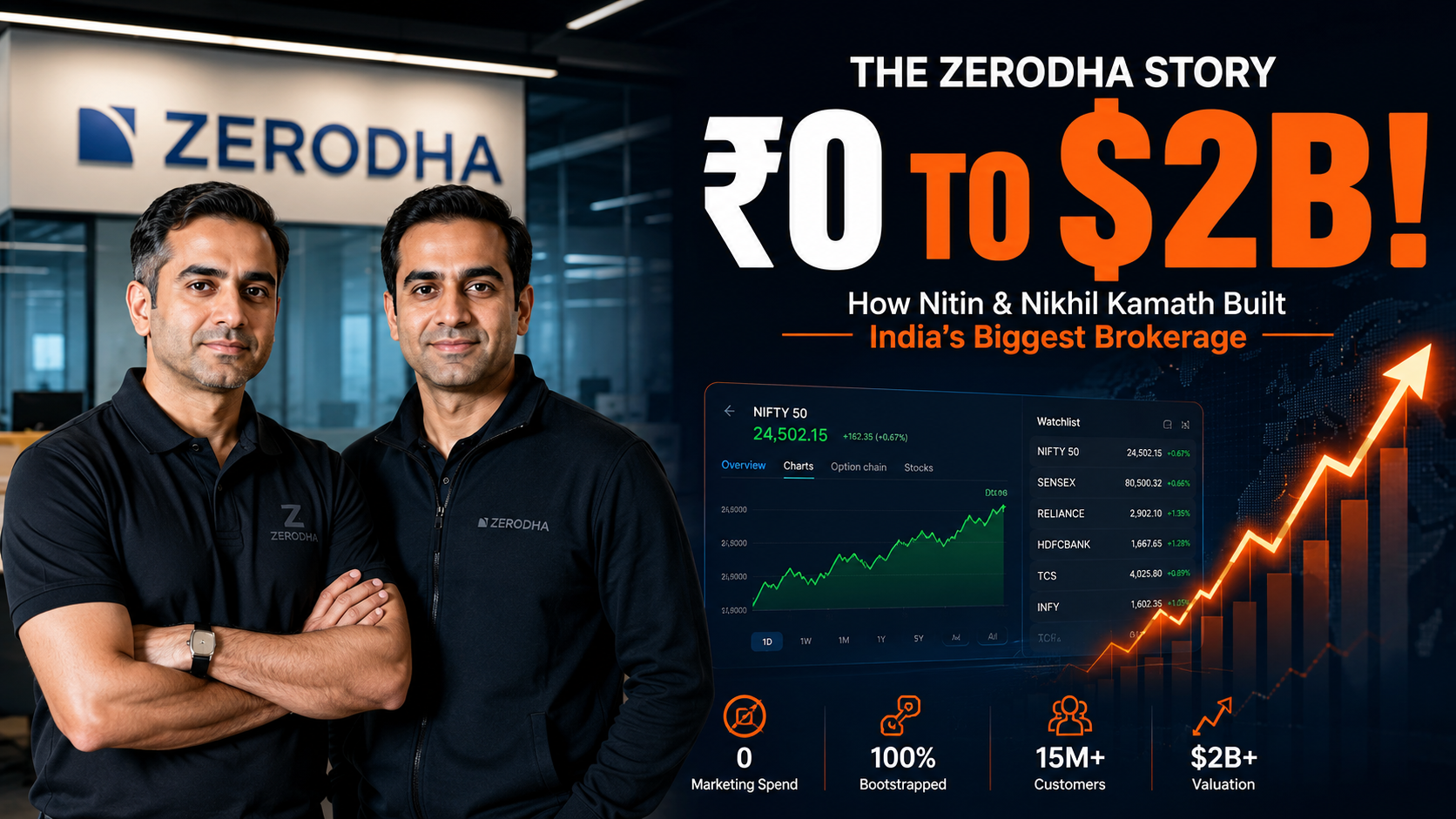
A $2 Billion Empire with ₹0 Marketing Budget
In a startup world obsessed with venture capital, massive burn rates, and relentless ad campaigns, Zerodha stands out as a glorious anomaly.
Without raising a single rupee from foreign VCs, two brothers from Bengaluru—Nitin Kamath and Nikhil Kamath—built India’s largest stock brokerage firm. Today, Zerodha handles millions of trades daily and generates hundreds of millions in profit, all while spending ₹0 on customer acquisition marketing.
How did a former call-center worker and a high school dropout disrupt India's financial landscape forever? Here is the unfiltered story of grit, product focus, and conviction.
1. The Backstory
Long before Zerodha was a household name, Nitin Kamath was a passionate 17-year-old trader. To support his trading habits and manage his capital, he worked night shifts at a call center for ₹8,000 a month and traded stocks during the day.
After losing his capital during the market crash of 2001–2002, Nitin didn't quit. Instead, he spent the next few years learning risk management, working as a sub-broker, and managing money for high-net-worth individuals.
Meanwhile, his younger brother, Nikhil Kamath, had dropped out of school at age 14 to play competitive chess. Nikhil later joined a call center at 17, where he quickly realized his knack for stock trading and financial markets.
By the mid-2000s, both brothers realized a fundamental flaw in the Indian stock trading market.
2. The Problem: Exorbitant Fees & Clunky Software
In 2010, trading in India was painful and expensive:
- Traditional brokers charged heavy percentage-based commissions on every trade.
- The trading software was slow, clunky, and complicated for everyday retail investors.
- Transparency was minimal, hidden charges were everywhere, and the barrier to entry was high.
Nitin realized that young Indians wanted to invest, but the traditional brokerage model was actively pushing them away.
That was the birth of Zerodha—a combination of the Sanskrit word ‘Zero’ and ‘Rodha’ (meaning barrier). Zero Barriers.
3. The Breakthrough Model: Flat Fee Brokerage
Launched in August 2010, Zerodha introduced a radical pricing model: A flat fee of ₹20 per trade, regardless of the transaction size.
While incumbents laughed at the model—claiming Zerodha would go bankrupt charging so little—the Kamath brothers focused relentlessly on two things:
1. In-house Tech Stack: Building fast, lightweight platforms like Kite (trading app) and Console (back-office dashboard).
2. Financial Literacy: Launching Varsity, a free educational portal to teach Indians how stock markets work without pushing them to trade blindly.
4. The Growth Engine: Word-of-Mouth & Trust
Zerodha never hired brand ambassadors or ran high-decibel IPL advertisements. Instead, they relied on:
- Product Efficiency: Kite became the smoothest trading application in India. Active traders loved the speed, which created an organic word-of-mouth loop.
- Zero Equity Dilution: By keeping the company bootstrapped, Nitin and Nikhil retained 100% control, allowing them to focus on long-term user trust rather than short-term quarterly targets for VC investors.
- Free Delivery Investments: In 2015, Zerodha made long-term equity investments completely free (₹0 brokerage), cementing its status as the most user-friendly broker in India.
5. Key Lessons for Founders & Entrepreneurs
1. Solve Your Own Problem First: Nitin was a trader himself. He built a platform he wished existed when he started out.
2. Focus on Customer Retention over Acquisition: If your product is 10x better than the competition, your users will become your sales team.
3. Patience over VC Hype: Building a profitable, sustainable business takes time. You don't need millions in funding to build a market leader.
4. Educate Your Audience: By creating Varsity, Zerodha didn't just capture existing traders—they created millions of new investors in India.
Conclusion
The story of Nitin and Nikhil Kamath proves that value creation always trumps valuation hype. By remaining customer-obsessed, lean, and ethically grounded, Zerodha turned from a small Bengaluru startup into India's most respected fintech titan.
What is your biggest takeaway from Zerodha's journey? Let us know in the comments below!