
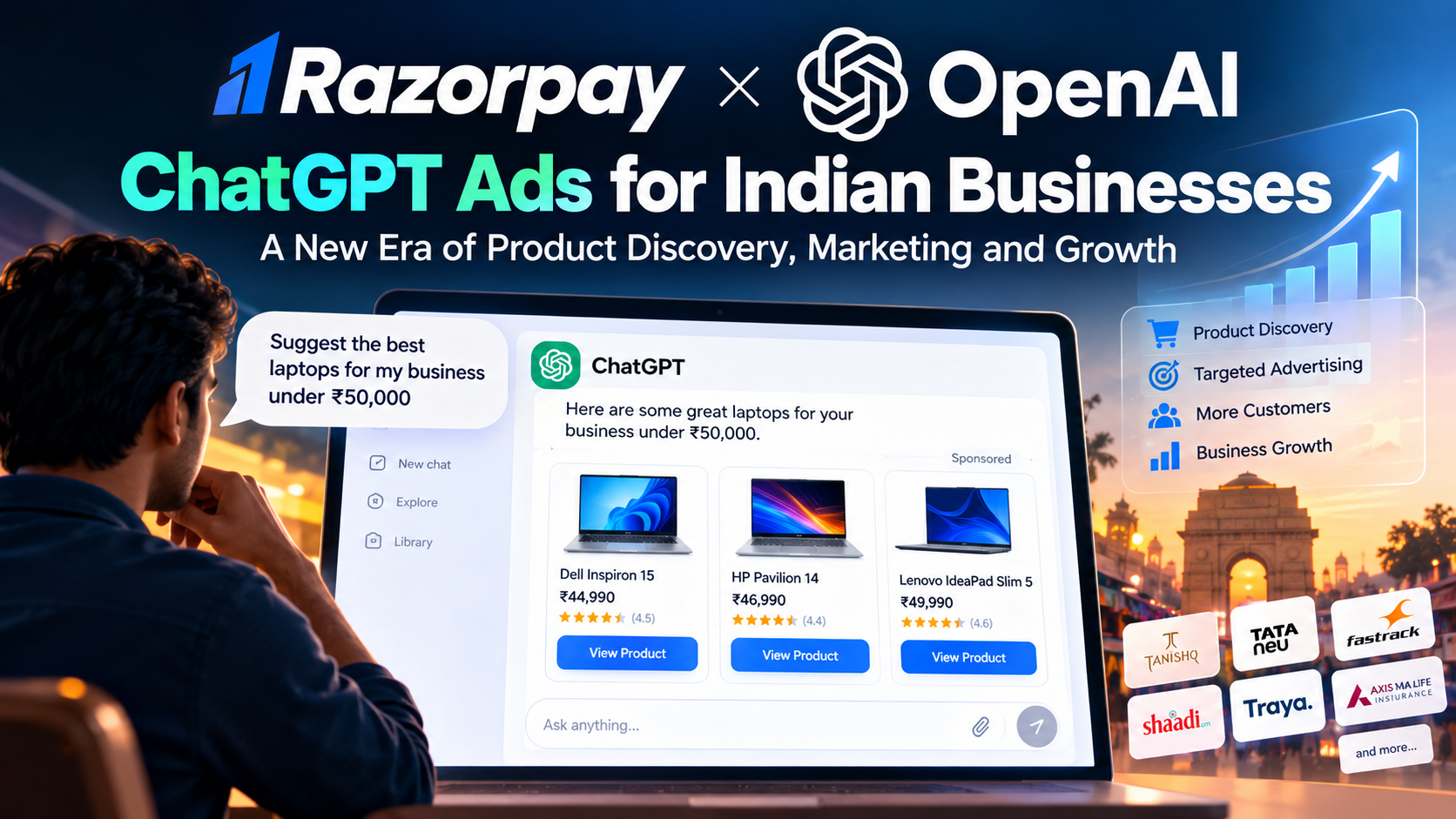
Razorpay and OpenAI have partnered to help Indian businesses advertise on ChatGPT through Razorpay Engage.
For years, businesses have competed for attention on Google, Instagram, Facebook and other digital platforms.
But the way customers discover products is changing.
Instead of searching Google for:
“Best skincare products for dry skin under ₹2,000”
a customer can now simply ask an AI assistant:
“I have dry skin. Suggest some good skincare products under ₹2,000.”
That small change has massive implications for businesses.
On October 5, 2026, Razorpay announced its partnership with OpenAI to help Indian brands launch and manage advertising campaigns on ChatGPT through Razorpay Engage, its growth marketing platform.
The partnership signals something bigger than a new advertising product.
The next battle for customer attention may not happen on search engines. It may happen inside AI conversations.
What Is the Razorpay and OpenAI Partnership?
Razorpay has partnered with OpenAI to help Indian businesses advertise their products and services on ChatGPT.
Through Razorpay Engage, businesses can get support with:
Preparing product catalogues
Structuring product feeds
Launching ChatGPT advertising campaigns
Managing campaigns
Tracking campaign performance
Optimising campaigns over time
Razorpay says Engage also uses an AI agent built around ChatGPT Ads best practices to help create and manage campaigns. Human oversight remains part of the process where judgement is required.
This is important because advertising on an AI platform is different from traditional keyword-based advertising.
Why Is ChatGPT Advertising Different From Google Ads?
Traditional search advertising is largely based on keywords.
For example:
Google Search:
“Best running shoes”
The advertiser can target the keyword “running shoes.”
But conversations with AI can contain much more information.
A user might say:
“I run 5 km every day on roads, have flat feet, want lightweight shoes and my budget is ₹5,000.”
That single conversation contains information about:
Product category
User requirements
Budget
Usage
Preferences
Problems
Purchase intent
This creates a fundamentally different advertising environment.
OpenAI describes ChatGPT Ads as a way for businesses to reach people while they explore options, compare alternatives and make decisions.
Search was keyword-driven.
AI discovery is conversation-driven.
And businesses will have to adapt.
How Razorpay Engage Will Help Indian Businesses
One of the biggest challenges for brands will not simply be buying an advertisement.
It will be making sure that their product information is structured properly for an AI-driven discovery environment.
Razorpay Engage is designed to help businesses prepare their catalogues and feeds before campaigns are launched.
The platform can help with:
1. Product Catalogue Preparation
Brands often have thousands of products with different descriptions, specifications and attributes.
Those catalogues need to be structured in a way that works effectively for conversational product discovery.
2. Product Feed Management
The same product may be relevant to many different customer questions.
A well-structured feed can help provide the information needed for those different contexts.
3. Campaign Management
Businesses can launch and manage ChatGPT Ads campaigns through the Engage platform.
4. Performance Tracking
Advertisers also need to understand whether campaigns are generating meaningful results.
Razorpay Engage is designed to help brands track and optimise campaign performance.
Which Indian Brands Are Already Participating?
The early group of brands participating in ChatGPT Ads through this initiative includes names such as:
Tanishq
Fastrack
Traya
Tata Neu
Rivaah by Tanishq
Shaadi.com
Axis Max Life
Palmonas
NMIMS
Razorpay has positioned these businesses as early participants in the new advertising channel.
The categories are also interesting.
They include:
Jewellery + Beauty + Wellness + Financial Services + Consumer Brands + Education
That suggests AI-based product discovery is not limited to one particular industry.
ChatGPT Is Becoming a New Product Discovery Channel
For startups, this development creates both an opportunity and a challenge.
Large companies can spend millions on advertising.
Startups usually cannot.
But AI-driven discovery could potentially give smaller brands another way to get discovered if their products are highly relevant to a specific customer requirement.
Imagine a customer asking:
“I need affordable accounting software for a small Indian business with GST invoicing.”
A traditional advertisement may target:
GST software
But an AI-driven environment can potentially understand the complete context of the user's requirement.
That changes how startups should think about marketing.
Instead of asking:
“Which keyword should I target?”
They may increasingly need to ask:
“Which customer problems should my product be the answer to?”
What Startups Should Learn From Razorpay
There is a bigger startup lesson here.
Razorpay did not simply build another advertising platform.
It identified a change in consumer behaviour:
People are changing how they discover products.
Then it positioned itself around that change.
That's an important founder lesson.
Successful startups don't always create new behaviour.
Sometimes they identify a behaviour that is already changing and build infrastructure around it.
The Bigger Picture
The internet has traditionally worked like this:
Customer → Search → Website → Product → Payment
AI could change the flow into:
Customer → AI Conversation → Recommendation → Product → Payment
And if that happens at scale, the search engine may no longer be the only gatekeeper between customers and businesses.
The AI assistant could become the new interface.
That is why the Razorpay and OpenAI partnership deserves attention.
It is not just about ads.
It is about who controls product discovery in the AI era.
Final Takeaway
The Razorpay and OpenAI partnership is an important signal for Indian businesses.
Google taught businesses how to rank.
Social media taught businesses how to capture attention.
AI may teach businesses how to become the answer.
For startups and businesses, the question is no longer only:
“How do I rank on Google?”
It may soon become:
“When my potential customer asks AI for a solution, will my company be part of the answer?”
That is the opportunity Indian businesses should start preparing for now.